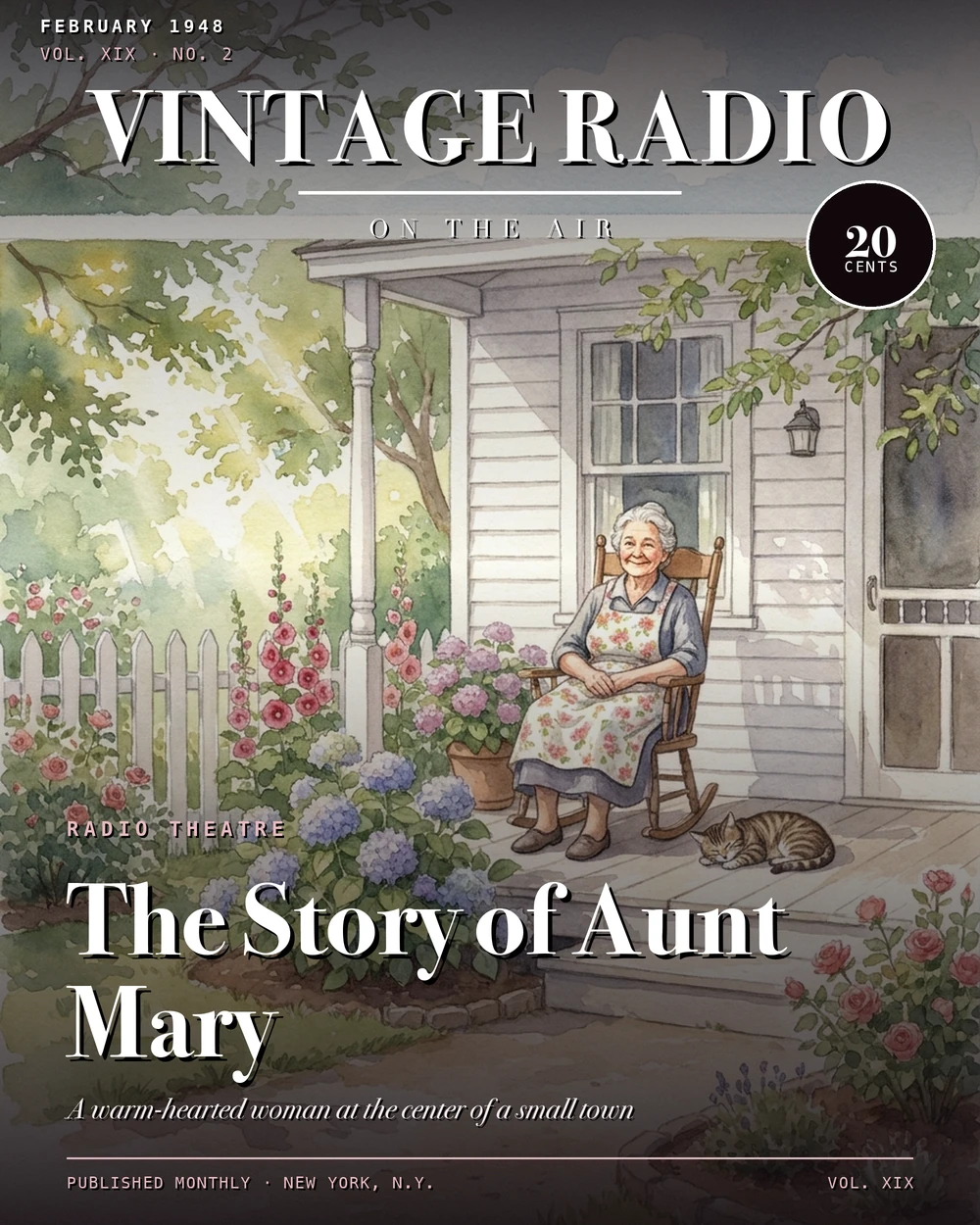
The Story of Aunt Mary
The Show and What It Was
The Story of Aunt Mary was a daytime soap opera built around one of radio's more quietly durable premises: a sensible, warm-hearted woman on a small chicken farm on the outskirts of Wakefield, a fictional American small town, serving as the steadying center of gravity for the people around her. That woman was Mary Lane, played by Jane Morgan, and the show's central relationships revolved around her niece Peggy Douglas Mead and a hired hand named Lefty Larkin — described in contemporary sources as a farmhand with a mysterious past. The world of Wakefield filled in over time with a recurring cast of characters — Brett, Jessie, Ben, Randy, Dr. Whitney, Kitt, David, Dr. Laraby — whose intersecting problems with wills, real estate deals, and medical consultations kept the storylines moving across the serial's long run.
The show broadcast in 15-minute episodes, the standard format for daytime serials, and ran from February 1944 through at least March 1961 — a span of roughly seventeen years. Despite the genre label it carries, Aunt Mary was never sponsored by a soap company. It began as a sustaining program and cycled through a succession of food and household-goods sponsors over its life. The name "soap opera" stuck to the format broadly, but this particular show's commercial history went its own direction.
How It Got on the Air and Spread
The program debuted in February 1944 on eight NBC stations in California and Arizona — KFI, KMJ, KPO, KFSD, KTAR, KVOA, KGLU, and KYZM — running Monday through Friday from 10:30 to 10:45 a.m. Pacific War Time. Seven months in, on September 11, 1944, it moved to a 3:45–4 p.m. slot and was by then carried on 12 NBC Western stations. By its first anniversary, the station count had grown to 20 NBC Pacific outlets.
The expansion east came through transcription — pre-recorded episodes shipped to stations rather than live feeds. Effective January 14, 1946, eastern stations WOR, WBAL, WBZ, WBZA, and KYW began carrying the program, with Hudson Pulp & Paper Corp. sponsoring those broadcasts in New York City, Baltimore, Boston, and Philadelphia. The show had gone from a California morning program to a multi-region serial in under two years. Then in 1948, NBC made a move that underlined just how seriously the network took Aunt Mary: it purchased the serial outright, the first daytime serial NBC had ever acquired the rights to, and made more than 600 transcribed episodes available for syndication across the United States and Canada. The following year, the show was performed live in Australia by an Australian cast working from scripts sent out of Hollywood — one of the more unusual examples of American radio drama crossing the Pacific in the 1940s.
The Sponsor Story
The Story of Aunt Mary never had a single long-running corporate patron the way some serials did. It moved through a sequence of sponsors that tracked its regional origins and gradual national growth. Los Angeles-based Ben Hur Products — a coffee, tea, and spices company later acquired by McCormick & Company — was its first commercial backer after the sustaining period. On February 19, 1945, Safeway Stores took over. By 1948, Albers Brothers Milling Company had become the sponsor on the West Coast side of the run, while Hudson Pulp & Paper handled the eastern markets from January 1946 onward.
None of these were soap manufacturers. The irony is mild but worth noting: the program ran as a soap opera for the better part of two decades while being supported by grocery chains, a spice company, a flour mill, and a paper corporation. What the sponsors shared was a practical interest in reaching the daytime audience of homemakers that the serial format reliably attracted. The show delivered that audience in numbers that justified the investment.
The People Behind It
The writing team for Aunt Mary centered on Leigh and Virginia Crosby, who developed and shaped the show across its run. Virginia Crosby brought substantial credentials to the job: she had previously been Irna Phillips's top writer, with credits on The Guiding Light, Road of Life, and Today's Children — a résumé that placed her at the center of 1930s and 1940s daytime serial writing. Leigh Crosby had been associated with General Mills radio shows before Aunt Mary. Additional writers on the program included Gil Faust and Virginia Thacker.
The show was directed by George Fogle and Edwin H. Morris. Fogle also directed Ma Perkins for seven years, giving him one of the more substantial daytime drama directing careers in network radio. The theme song was "Dear Old Girl," and the format — 15 minutes, five days a week, ongoing storylines — matched the template that defined the genre.
The Cast
Jane Morgan brought Mary Lane to life for the full run of the serial. Born in Britain in 1880, Morgan came to American radio in 1930 and built a career that would stretch for decades. She is probably best remembered today for playing Mrs. Davis — Eve Arden's landlady — on both the radio and television versions of Our Miss Brooks. Her work on Aunt Mary came from the same corner of her range: a warm, grounded character who held a world together.
Jane Webb played Peggy Douglas Mead, Aunt Mary's niece. Born in 1925, Webb had started in radio as a child performer in Chicago and went on to a long career in voice work, becoming well known for her contributions to Filmation animated series including Sabrina the Teenage Witch and The Archie Show. Fred Howard played Lefty Larkin, the farmhand with a past. Additional cast members included Tom Collins, Cy Kendall, and Betty Gerson, though the specific roles they played aren't documented in surviving sources.
Why It Lasted
A program doesn't run for seventeen years and expand from eight California stations to syndication across the United States, Canada, and Australia without building genuine listener loyalty. According to a Broadcasting magazine article marking the show's fifth anniversary, Aunt Mary consistently ranked in the top 15 of daytime Hooper ratings and typically placed among the first five programs — national and regional combined. That was strong performance for any daytime serial, let alone one that started as a sustaining program on a regional NBC network.
One data point captures the connection listeners felt: when the show was dropped in a single market, more than 400 letters arrived within a single week asking why it had been cancelled and when it was coming back. That kind of response didn't happen for programs listeners treated as background noise. The 583 catalogued episodes that survive are drawn from a run that NBC itself decided was worth purchasing outright — a commercial and institutional vote of confidence that helps explain how a small-town chicken farmer from Wakefield stayed on the air long enough to still be listed among NBC's syndicated offerings as late as March 1961.